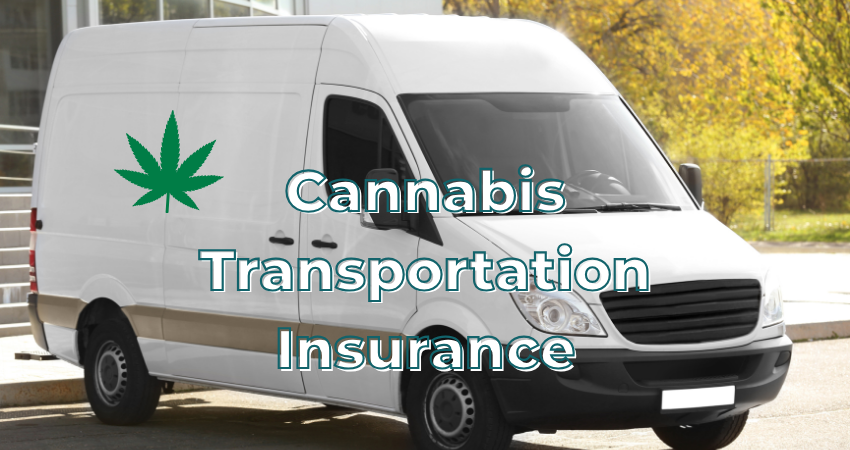
Moving cannabis product between licensed premises is one of the riskiest parts of the business, and one of the most commonly under-insured. Many transporters start with the auto policy they already have, whether it's a personal policy on a company van or a commercial policy that was written for delivering something else. That policy usually doesn't respond the way you'd expect when a load is stolen, a driver is in an accident, or a state regulator asks for proof of coverage.
Short answer: A personal auto policy generally excludes vehicles used for business, and even a standard commercial auto policy often doesn't cover the cargo itself. For cannabis transporters, you need a policy structure that addresses the product in transit, theft and hijacking, the vehicle, and the employees who drive it. State transport rules add their own requirements on top.
Why doesn't a personal auto policy cover cannabis transport?
Personal auto policies are written for private use. They typically exclude vehicles used to carry goods for hire or in connection with a business. The exclusion matters most for drivers who take a company vehicle, a cargo van, or a box truck on regular routes. If an accident happens during a business run, the insurer may deny the claim, leaving the driver, the business, or both exposed.
Even when a vehicle is classed as a commercial risk, the cargo is a separate question. Auto liability covers injury and property damage to other people. It doesn't cover the product you're carrying. That's why cargo coverage, often called motor truck cargo, exists as its own line. Without it, a loss of your product in an accident or a theft may not be covered at all.
What does a commercial auto policy miss for cannabis cargo?
A commercial auto policy is the right starting point for a transporter, but a generic one isn't enough. Cannabis transport creates gaps that a standard form doesn't address:
- Cargo valuation. Product in transit can carry a high value relative to the vehicle. Limits set for general freight may be far too low, and the valuation method in the policy determines what you actually get paid after a loss.
- Theft and hijacking. Theft from a vehicle, hijacking, and theft at a stop are separate exposures from a collision. Some policies exclude theft unless specific conditions are met, such as a locked, alarmed compartment or an attended vehicle.
- Hired and non-owned exposure. If you use leased vehicles, rented vehicles, or drivers' own cars for business trips, you need hired and non-owned auto coverage to respond.
- Employee injury. Drivers and loaders are employees. Workers' compensation applies whether or not the vehicle is insured, and it's worth confirming that your workers' comp classification reflects transport work.
Why is cargo theft a bigger concern right now?
Cargo theft is growing in dollar terms even as incident counts shift. Verisk CargoNet reported estimated cargo theft losses of about $725 million in 2025, a 60% increase over the prior year. In the second quarter of 2026, CargoNet estimated losses of $304.6 million, more than double the same quarter in 2025, even though the number of incidents fell. Its analysis says organized groups are becoming more selective, targeting fewer but higher-value loads, with the average stolen commodity value rising in 2026.
CargoNet's reporting covers cargo theft across all commodities, not cannabis specifically. The trend still matters for cannabis transporters, because it shows that high-value loads attract organized, targeted theft, and that the losses are large enough to change how carriers price the exposure.
What do state transport rules add?
Cannabis transport is regulated at the state level, and the rules vary. Some states require every transport to be documented with a manifest generated from the state's seed-to-sale tracking system. In Montana, for example, a valid transport manifest from the tracking system must accompany marijuana transportation, and manifests generally can't be changed after the vehicle leaves the originating premises. Other states set vehicle and security rules. Minnesota requires a standard operating procedure for licensed transporters, and rules in various states call for lockable containers, alarmed vehicles, and GPS tracking.
Those requirements are not just compliance tasks. Insurers ask about them during underwriting, and a loss that happens during a noncompliant transport can create a coverage dispute. Keep your manifests, your SOPs, and your vehicle security documentation organized, and confirm the requirements in each state you operate in.
What should a cannabis transporter ask about coverage?
When you review or quote a transport program, make sure the policy addresses each of these:
- Cannabis cargo coverage for the product in transit, at a limit that reflects your highest-value load.
- Commercial auto liability for injury and property damage caused by your vehicles.
- Hired and non-owned auto for leased, rented, or employee-owned vehicles used on business.
- Theft and hijacking coverage, including any conditions tied to vehicle security or attendance.
- General liability for operations that extend beyond driving.
- Workers' compensation that matches the actual duties of your drivers and loaders.
Then compare the conditions, not just the limits. Two policies with the same cargo limit can pay very differently after a theft depending on the exclusions and security requirements.
What can I do now to reduce my transport risk?
Coverage is only part of the picture. Carriers reward transporters who can show how they manage the exposure:
- Route and schedule discipline. Vary routes where your operations allow, avoid predictable stops, and limit time with product sitting unattended.
- Vehicle security. Use locked, alarmed compartments, and confirm that alarms and tracking work before each run.
- Driver vetting and training. Document background checks, driving records, and training on theft prevention and incident response.
- Manifest and documentation hygiene. Keep manifests, delivery records, and chain-of-custody documentation complete for every load.
- Loss-response plan. Know who to call, what to document, and how to notify carriers and regulators after an incident.
Get a transport program built around your operation
If your transport program is running on a personal policy, a generic commercial auto form, or a renewal you haven't reviewed in a while, it's worth a closer look. Spire is an independent specialty agency, and cannabis transportation is one of our core lines. We'll review your fleet, your loads, your state requirements, and your current policies, and show you where the gaps are.
To get a starting range, use our free cannabis insurance cost estimator, or learn more about our secure cannabis transportation coverage. When you're ready, request a commercial quote.
This article is for general educational purposes and is not legal, tax, or insurance advice. State transport requirements change, and the rules described here may not apply in your state. Coverage always depends on the terms, conditions, and exclusions of your policy. Please consult a licensed Spire specialist and your state regulator about your operation.
Sources & further reading:
- Verisk CargoNet — "Cargo theft losses more than double to $304 million in Q2 despite a drop in thefts driven by high value metals and technology heists" — https://www.verisk.com/company/newsroom/cargo-theft-losses-more-than-double-to-$304-million-in-q2-despite-a-drop-in-thefts-driven-by-high-value-metals-and-technology-heists/
- Verisk CargoNet — "Cargo theft losses surge to estimated $725 million in 2025" — https://www.verisk.com/company/newsroom/cargo-theft-losses-surge-to-estimated-$725-million-in-2025-verisk-cargonet-analysis-reveals/
- Montana Department of Revenue — "Intrastate Transportation of Marijuana by Licensees" — https://revenue.mt.gov/files/Cannabis/Intrastate-Transportation-of-Marijuana-by-Licensees.pdf
- Minnesota Rules, ch. 9810, pt. 9810.2300 (Transportation) — https://www.law.cornell.edu/regulations/minnesota/Minn-Stat-agency-198-ch-9810-pt-9810.2300
.png)




.png)